On-chain CFDs
On-chain CFDs are contracts for difference that execute and settle entirely on a blockchain, allowing traders to gain leveraged exposure to stocks, forex, indices, and commodities directly from a crypto wallet, without a broker, brokerage account, or centralized counterparty. Carbon is a decentralized exchange that offers 200+ on-chain CFD markets at launch through solver-based execution on Arbitrum, sourcing real liquidity from professional market makers connected to traditional financial venues. All trades are fully on-chain, self-custodial, and settled in USDC.
What Are CFDs?
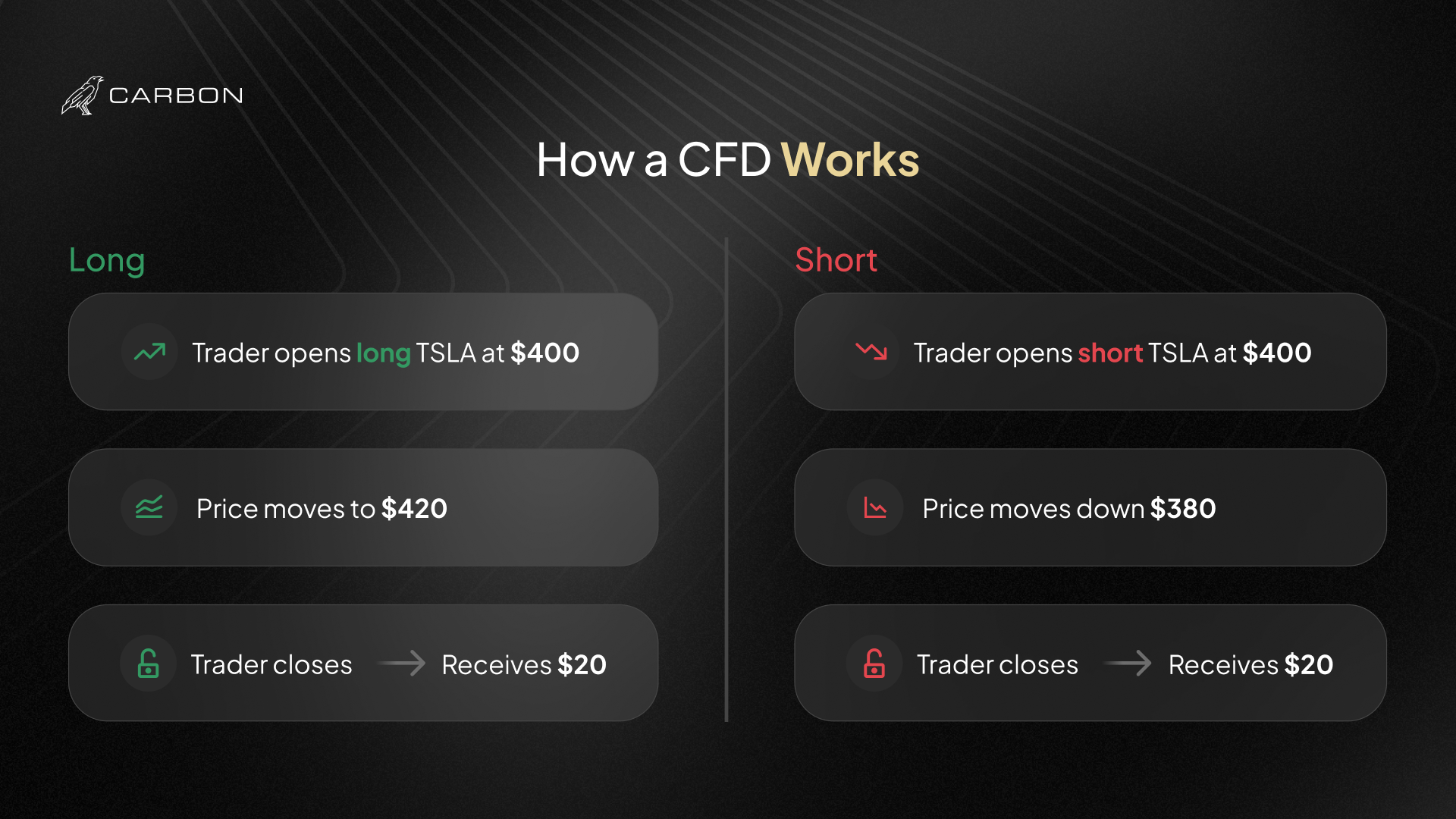
A contract for difference is a derivative instrument. Two parties agree to exchange the difference in an asset's price between when the contract opens and when it closes. You never buy or hold the underlying asset. If you open a long CFD on Tesla at $400 and close it at $420, you receive the $20 difference. If it drops to $380, you pay it.
CFDs are one of the most widely used instruments in traditional finance. They generate over $30 trillion in monthly volume globally and are the primary way retail and institutional traders access stocks, indices, forex, and commodities with leverage. Every major online broker (eToro, IG, Plus500, Pepperstone) is fundamentally a CFD platform.
The instrument is simple. The infrastructure it runs on is not.
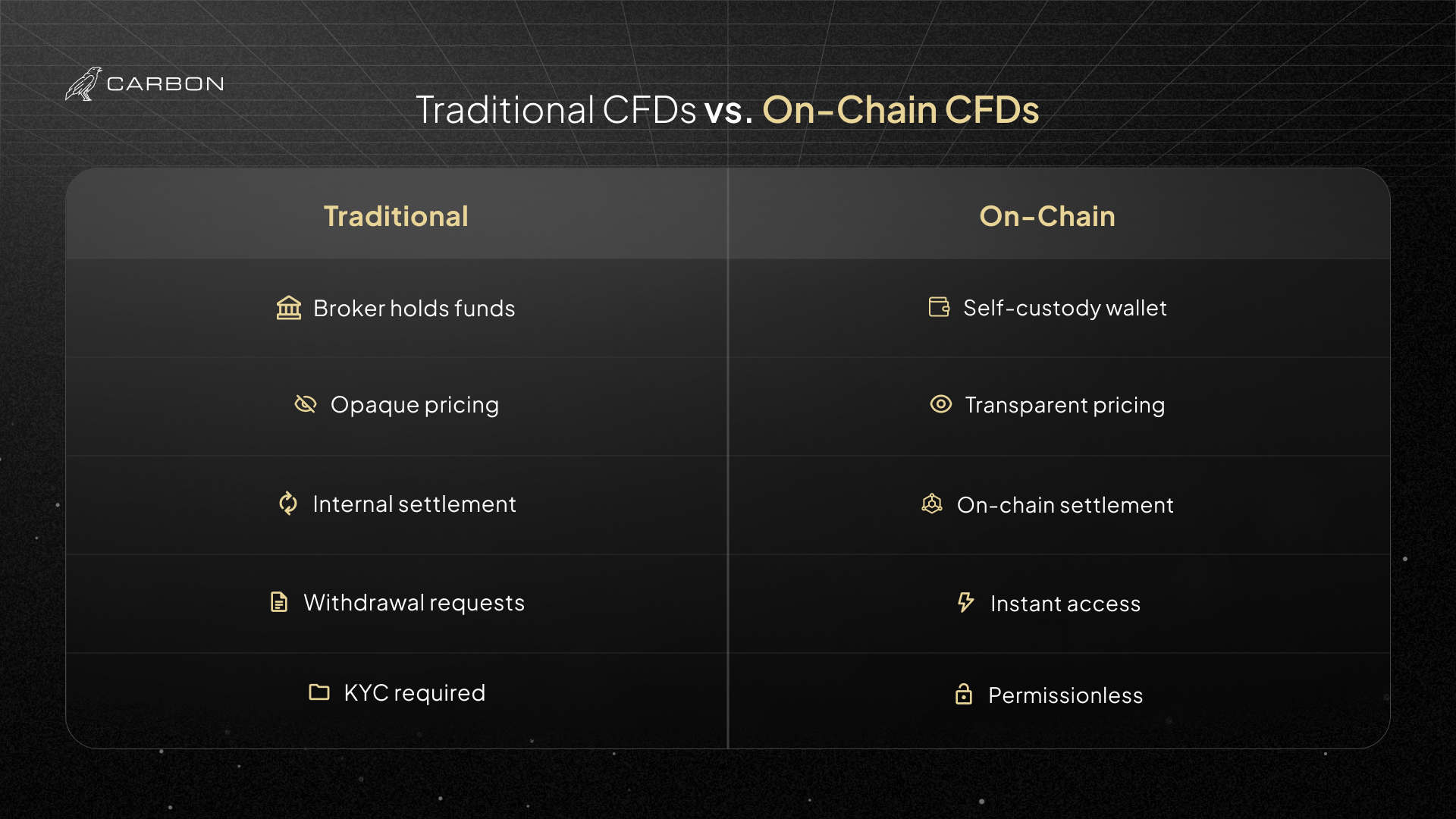
Traditional CFDs depend on a centralized broker who acts as your counterparty. The broker holds your funds, sets your margin requirements, controls your withdrawals, and can adjust terms at will. Pricing is often opaque. Settlement is internal to the broker's systems, not auditable. If the broker fails or acts against your interest, you have limited recourse, especially outside well-regulated jurisdictions.
This is the problem on-chain CFDs solve.
What Makes a CFD "On-chain"?
When a CFD is on-chain, the entire lifecycle of the trade (opening, margin management, settlement) is handled by smart contracts on a public blockchain, not by a broker's internal systems.
This changes the trust model fundamentally.
Self-custody. Your collateral stays in your wallet until a trade is opened, and your positions are held in smart contracts you can verify. No broker holds your funds. No withdrawal requests. No account freezes.
Transparent settlement. Every trade, every position, every liquidation is recorded on-chain and auditable in real time. There is no black box. The price you got, the margin you posted, and the settlement you received are all publicly verifiable.
No counterparty risk against a broker. In traditional CFDs, the broker is your counterparty. Their profit is often your loss. On-chain CFDs remove this conflict by using a solver-based model where professional market makers compete to fill your trades and hedge their exposure on external venues.
Permissionless access. Connect a wallet, deposit USDC, and trade. No application process, no brokerage account, no geographic restrictions imposed by a single broker's compliance department.
What Can You Trade?
On-chain CFDs unlock the same asset classes that traditional CFD brokers offer, but through decentralized infrastructure.
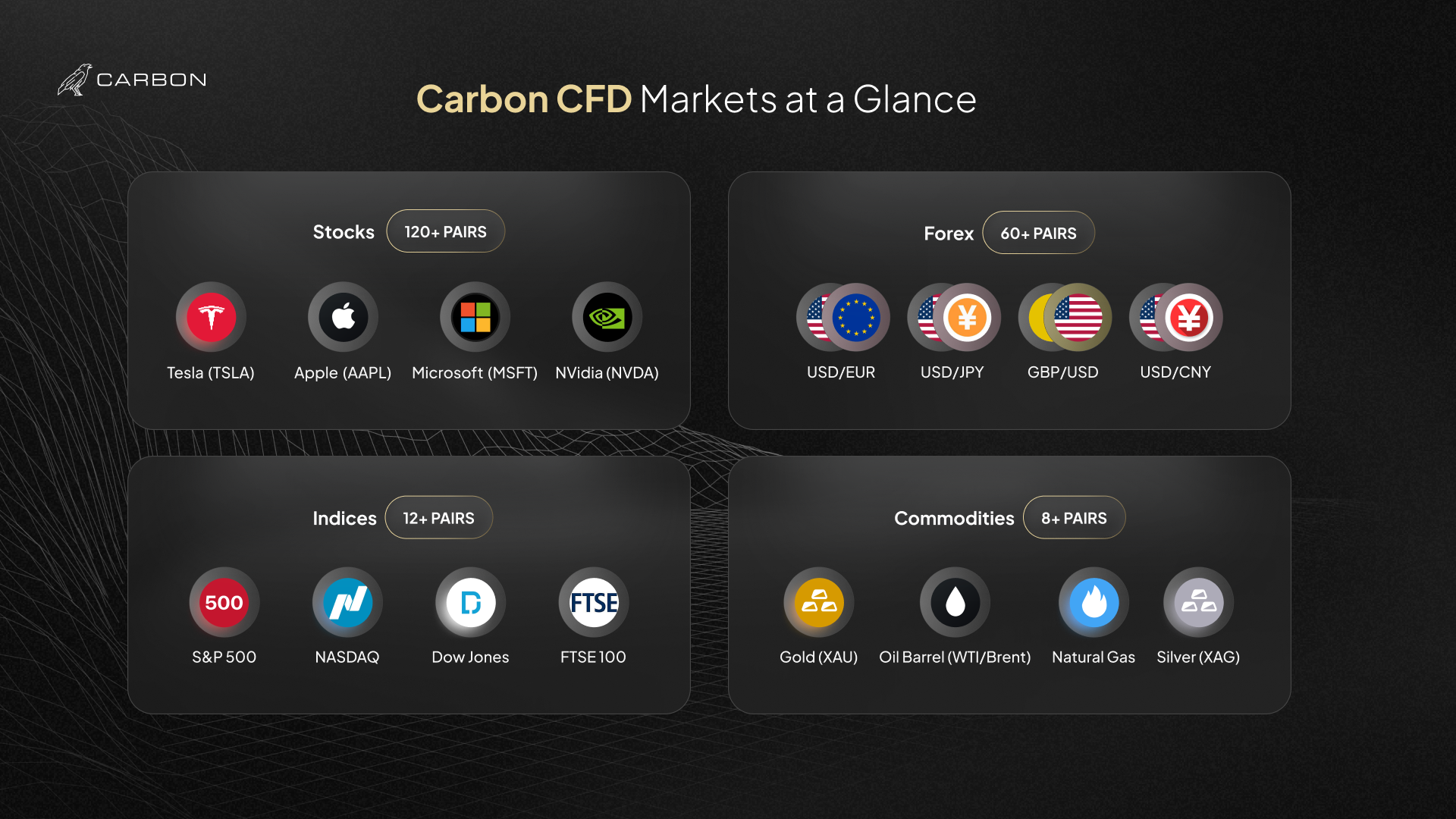
On Carbon, the initial CFD launch includes 200+ markets across four asset classes:
Stocks. 120+ equity CFDs covering the world's most traded companies: Tesla, Apple, Microsoft, Nvidia, Amazon, Coinbase, Palantir, and more. Perpetual contracts that track the stock price, tradeable from a crypto wallet with leverage up to 40x.
Forex. 60+ currency pairs including all the majors (EUR/USD, GBP/USD, USD/JPY) and a range of crosses and exotics. Deep liquidity sourced from institutional FX venues through Carbon's solver network.
Indices. 12+ global indices including the S&P 500, NASDAQ, Dow Jones, FTSE 100, and Nikkei 225. Trade the broad market without picking individual stocks.
Commodities. 8+ commodities including gold (XAU), silver (XAG), oil (WTI/Brent), and natural gas. On-chain access to the raw materials that move the global economy.
All of these settle on Arbitrum in USDC. No need to bridge between chains or manage multiple collateral types.
How Carbon Delivers On-chain CFDs
The challenge with putting CFDs on-chain is liquidity. Traditional CFD brokers can offer tight spreads on Tesla or EUR/USD because they're connected to deep institutional liquidity pools. A naive on-chain implementation using AMM-style liquidity pools would produce wide spreads and thin depth on anything outside major crypto pairs.
Carbon solves this with a solver-based execution model.
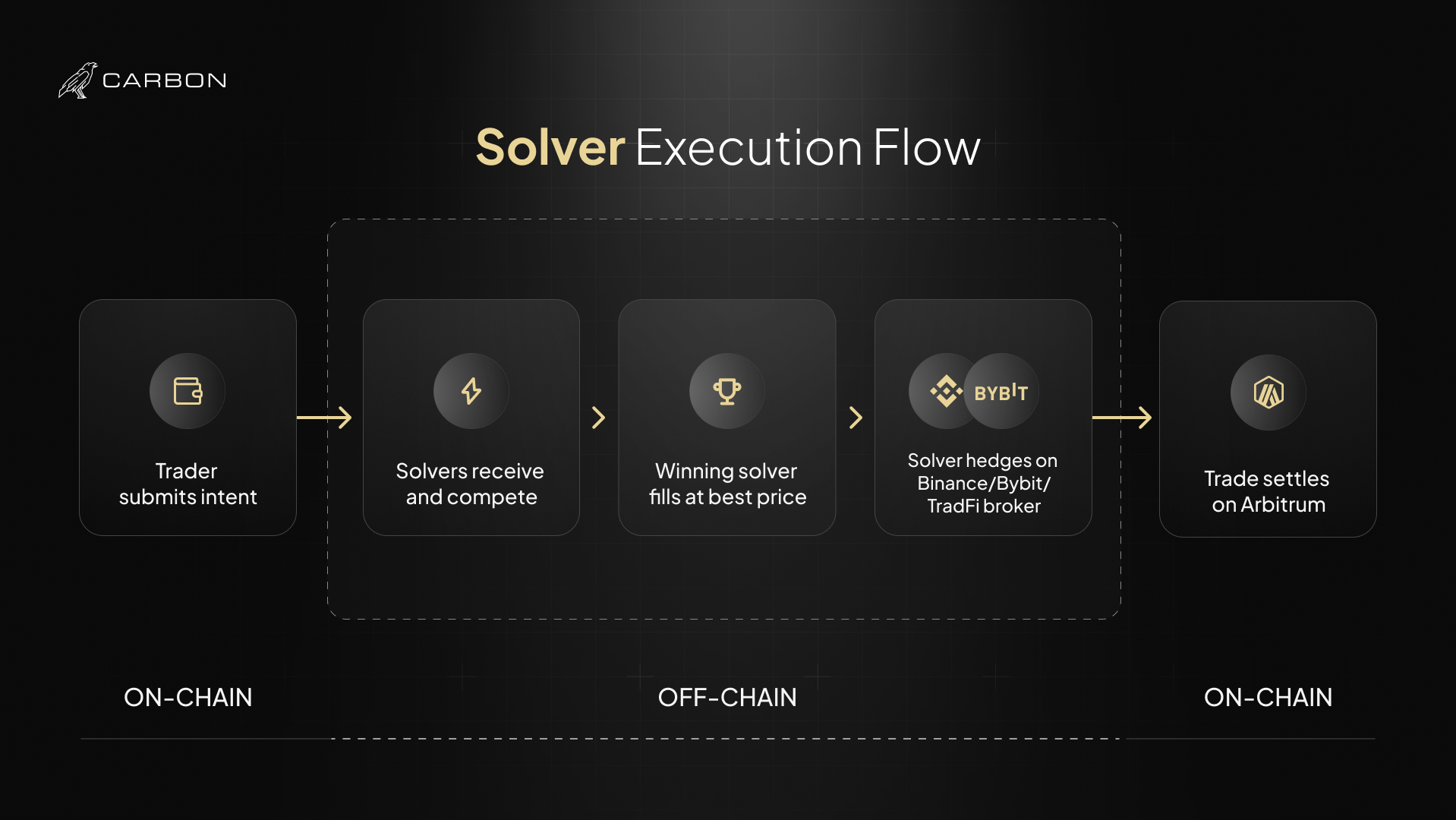
- You submit an intent. You sign a trade intent, for example "long AAPL at 20x leverage." This intent is broadcast to Carbon's solver network. It does not execute immediately against a pool.
- Solvers compete to fill your trade. Professional market makers (solvers) connected to Carbon's network see your intent and compete to offer the best price. These solvers have direct connections to major exchanges and traditional financial brokers.
- Solvers hedge on external venues. When a solver fills your trade, they simultaneously hedge their exposure on the relevant market. For stock CFDs, that means hedging against real stock prices through connected TradFi brokers. For crypto pairs, solvers hedge on Binance, Bybit, and other major CEXs.
- Settlement happens on-chain. Despite the liquidity originating from centralized venues, your trade settles fully on Arbitrum. Your margin, your position, and your P&L are all managed by smart contracts. The solver's hedging activity is invisible to you. You get real depth and tight spreads on-chain.
This model is built on the SYMMIO protocol, which provides the smart contract infrastructure for bilateral derivatives. It enables provably solvent positions, transparent margin management, and atomic settlement, all on-chain.
The result: CEX-quality liquidity and pricing on a self-custodial, decentralized platform. The solvers take on the complexity of connecting to external venues. You just trade.
On-chain Equities: How Different Approaches Compare
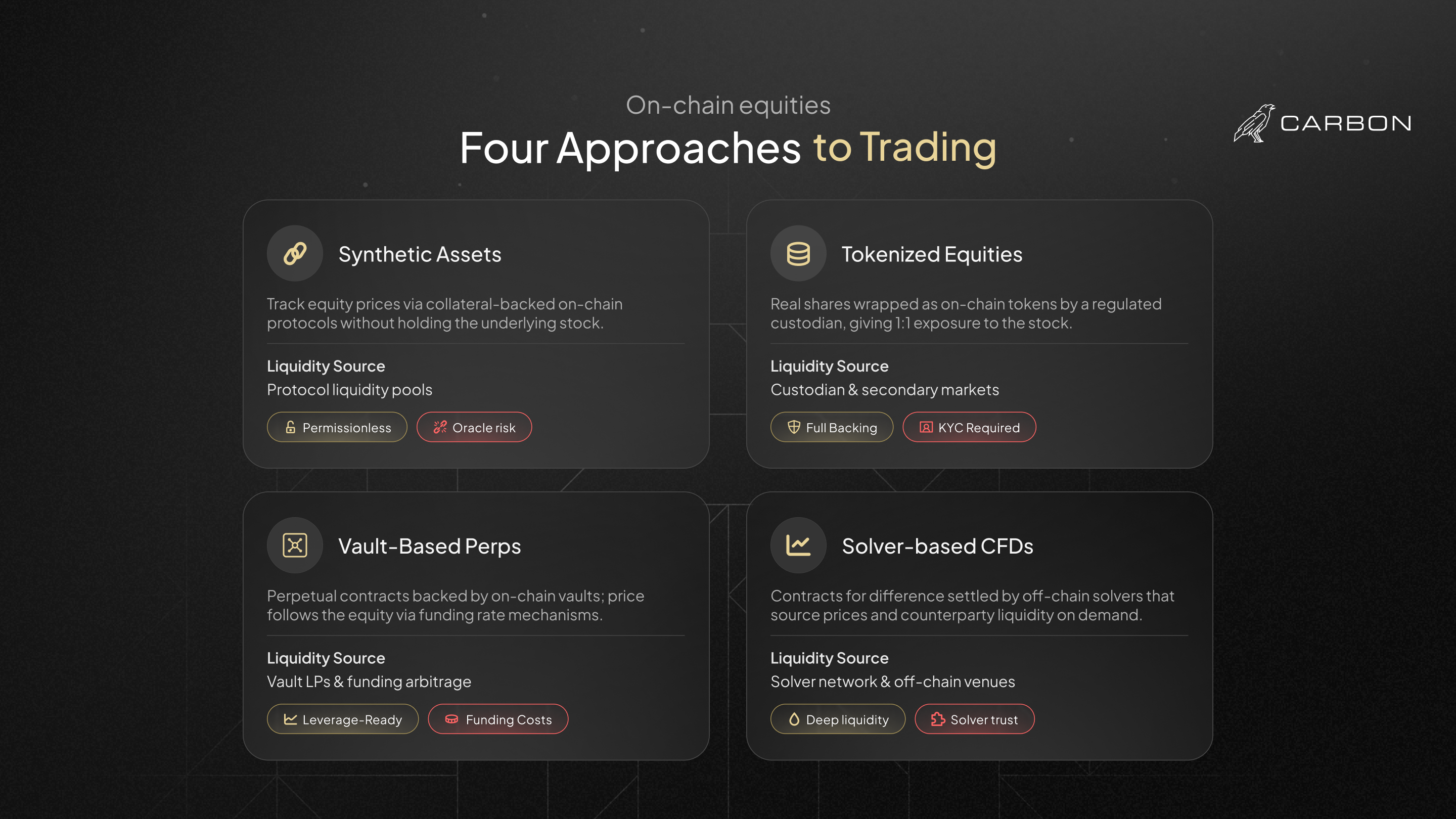
Carbon's on-chain CFDs are not the only way to get equity exposure on-chain. Several approaches exist, each with a different architecture and different trade-offs. Understanding what separates them matters if you're evaluating where to trade.
Synthetic asset protocols (like Synthetix) create synthetic tokens that track asset prices using overcollateralized debt positions and oracle price feeds. This model works without external liquidity connections, but it carries significant limitations. Liquidity is constrained by the collateral pool, spreads widen as utilization increases, and the system depends heavily on oracle accuracy. For major crypto pairs this can function well. For hundreds of stock and forex pairs with tight spreads, it struggles to scale.
Tokenized equities attempt to bring actual stock ownership on-chain. Projects in this space (Backed's xStocks, Kraken's tokenized stocks, Robinhood's international offering) wrap regulated securities into blockchain tokens, giving holders a claim on the underlying shares. The problem is operational. It requires licensed custodians, regulatory approval in multiple jurisdictions, and redemption infrastructure. Liquidity is typically thin because the tokens trade in isolated on-chain pools rather than drawing from deep equity markets. And the regulatory surface area is massive. The SEC has not offered formal guidance on tokenized versions of registered securities traded offshore, and many projects have restricted access or shut down entirely.
Perpetual contracts on equities (like Ostium's 0DTE perps) use perpetual swap mechanics adapted for stocks. These instruments track equity prices but use AMM or vault-based liquidity models rather than connecting to external venues. Depth depends entirely on how much capital sits in the vault. For a handful of high-volume stocks this can work. For 120+ equities across global markets, vault-based models struggle to provide consistent depth.
On-chain CFDs with solver-based execution (Carbon's approach) take a different path. Instead of building liquidity from scratch on-chain, Carbon's solvers source it from where it already exists: Binance, Bybit, and institutional TradFi brokers. The solver competition model means pricing reflects real market depth, not the size of an on-chain pool. This is why Carbon can launch 200+ CFDs across stocks, forex, indices, and commodities with tight spreads from day one, rather than starting with a handful of pairs and hoping liquidity grows organically.
| Synthetic Assets | Tokenized Equities | Equity Perps (vault-based) | On-chain CFDs (solver-based) | |
|---|---|---|---|---|
| Liquidity source | Collateral pool | Isolated on-chain pools | Vault deposits | External venues (CEX + TradFi) |
| Depth at launch | Limited by pool size | Typically thin | Depends on vault TVL | Real market depth via solvers |
| Asset coverage | Limited pairs | Very few, regulatory constraints | Small selection | 200+ at launch |
| Spreads | Widens under utilization | Often wide | Variable | Competitive, market-derived |
| Regulatory risk | Moderate | Very high | Moderate | Moderate |
| Oracle dependency | High | Low | High | Moderate (solvers provide pricing) |
| Self-custody | Yes | Varies | Yes | Yes |
No approach is perfect. Synthetic models have composability advantages. Tokenized equities offer actual ownership claims where they're legally viable. Carbon's solver model trades those properties for something different: real liquidity depth across a wide range of markets, sourced from the venues that already have it.
On-chain CFDs vs. Traditional CFD Brokers
| Traditional CFD Broker | Carbon (On-chain CFDs) | |
|---|---|---|
| Custody | Broker holds your funds | Self-custody, your wallet, your keys |
| Counterparty | The broker (conflict of interest) | Professional solvers competing for best price |
| Transparency | Internal settlement, opaque pricing | All trades settled and auditable on-chain |
| Access | KYC, brokerage application, geo-restrictions | Connect wallet, deposit USDC, trade |
| Settlement | Broker's internal ledger | Arbitrum blockchain |
| Withdrawal | Request-based, can take days | Direct from smart contract, immediate |
| Asset coverage | Stocks, forex, indices, commodities | Same: 200+ markets at launch |
| Leverage | Varies, typically 5-30x | Up to 40x |
| Fees | Spreads + commissions + overnight fees | Spreads only, zero trading fees |
The instrument is the same. The infrastructure is fundamentally different. On-chain CFDs remove the broker from the equation and replace trust with transparency.
Why On-chain CFDs Matter
CFDs are a $30 trillion monthly market, but they've been locked behind centralized brokers for their entire history. The instrument itself is simple and elegant. It's the infrastructure around it that creates problems.
On-chain CFDs fix the infrastructure while keeping the instrument. They bring TradFi's most popular derivative to a system where every trade is auditable, every position is self-custodial, and every settlement is final.
For crypto traders, this means access to traditional markets (stocks, forex, commodities) without leaving the on-chain ecosystem. You trade Apple stock the same way you trade BTC perps, from the same wallet, on the same platform.
For traditional traders, this means access to the benefits of blockchain (self-custody, transparency, permissionless access) without giving up the instruments and asset classes they already understand.
Carbon is building the bridge between these two worlds. Not by tokenizing stocks or commodities, which introduces custody, legal, and operational complexity. Instead, by bringing real-world liquidity to on-chain derivatives through a solver network that connects directly to traditional financial venues.
200+ CFD markets at launch. Deep TradFi liquidity. Fully on-chain. One terminal for everything.
Start Trading
Carbon's on-chain CFDs are launching soon. In the meantime, trade 550+ crypto perpetual pairs with zero fees and up to 75x leverage.