On-chain RWA Trading
On-chain RWA trading allows users to gain price exposure to real-world assets — including stocks, forex pairs, indices, and commodities — directly through a decentralized exchange, without a brokerage account or custodian. Carbon offers 200+ RWA trading pairs settled on-chain on Arbitrum, with liquidity sourced through professional solvers connected to traditional financial markets and major exchanges.
What Is RWA Trading in DeFi?
Real-world asset (RWA) trading in DeFi refers to gaining price exposure to assets that exist outside the blockchain — stocks, currencies, commodities, indices — through on-chain infrastructure. You don’t hold the underlying asset. You hold a position that tracks its price, managed by smart contracts and settled on-chain.
The term RWA has been applied broadly in crypto to describe anything from tokenized US Treasuries to on-chain gold. In the context of derivatives trading, it has a specific meaning: gaining leveraged or unleveraged price exposure to real-world asset prices without going through traditional financial infrastructure.
Traditional financial infrastructure creates significant friction for large parts of the global population. Brokerage accounts require KYC, often take days to open, and require local bank connections. Geographic restrictions prevent many users from accessing certain markets. Trading hours limit when you can act on information. Custody sits with a broker, creating counterparty risk. Leverage on traditional assets requires margin approval and significant minimum capital.
On-chain RWA trading removes most of this friction. Connect a wallet, deposit USDC, and trade Apple stock, EUR/USD, or gold — without a broker, without a custodian, and with your collateral held in a smart contract you can audit.
What Assets Can You Trade?
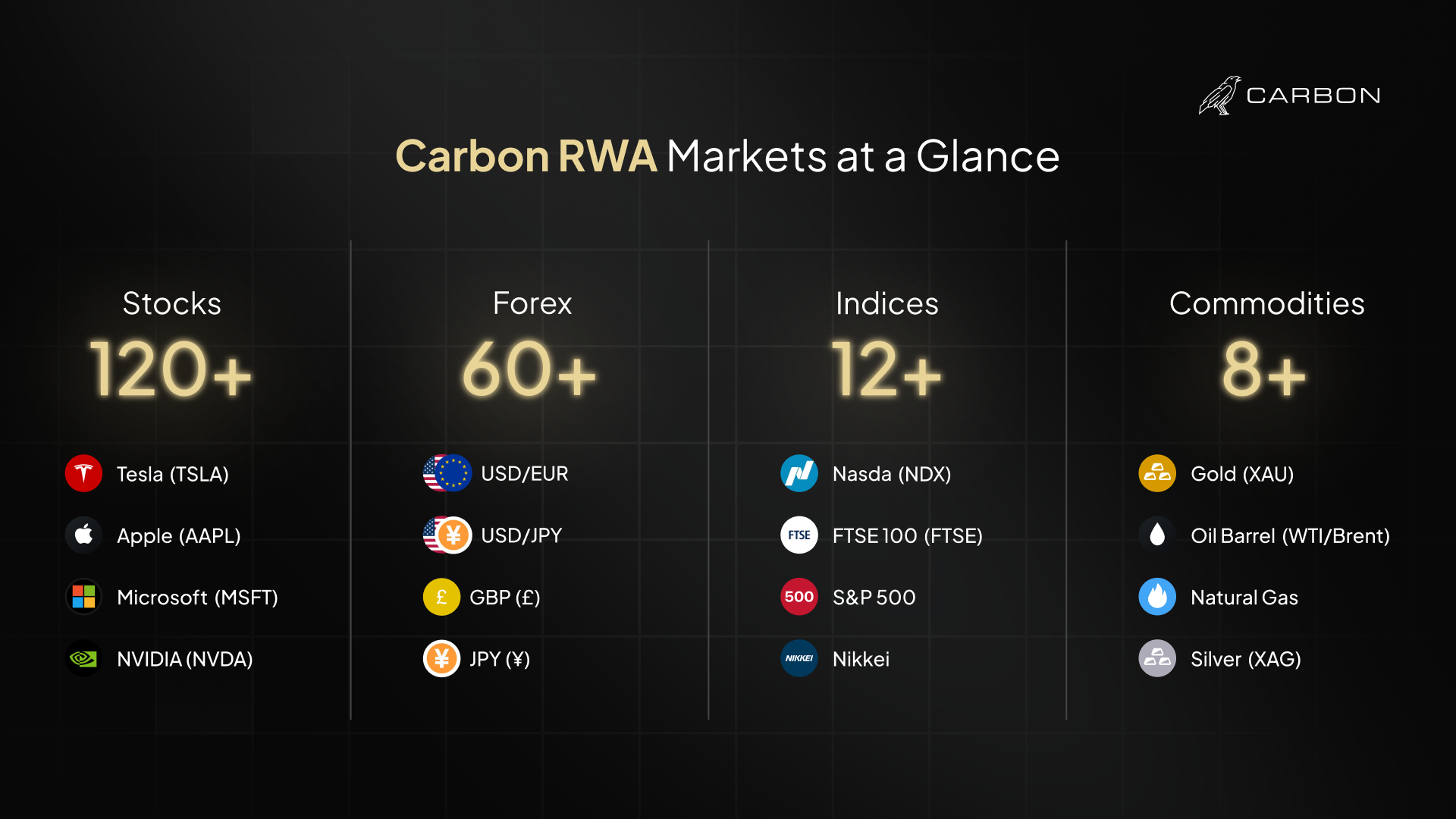
Carbon’s initial RWA launch covers 200+ markets across four asset classes.
Stocks. 120+ equity CFDs covering the world’s most actively traded companies. This includes the dominant US tech names — Tesla, Apple, Microsoft, Nvidia, Amazon — as well as high-growth names like Palantir, Coinbase, and Robinhood, and a range of global equities. These are perpetual contracts that track the underlying stock price with leverage up to 40x.
Forex. 60+ currency pairs spanning all major pairs (EUR/USD, GBP/USD, USD/JPY, USD/CHF) through to crosses and selected exotics. Liquidity is sourced through Carbon’s solver network from institutional FX venues, delivering real interbank-quality depth.
Indices. 12+ global indices including the S&P 500 (SPX), NASDAQ 100 (NDX), Dow Jones Industrial Average (DJI), FTSE 100, DAX, Nikkei 225, and others. Trading indices on-chain lets you take broad market positions without selecting individual stocks.
Commodities. 8+ commodity markets including gold (XAU/USD), silver (XAG/USD), crude oil (WTI and Brent), and natural gas. On-chain access to the raw materials that underpin the global economy.
All of these settle in USDC on Arbitrum. No need to bridge between chains, manage multiple collateral types, or operate across different platforms. One wallet, one collateral currency, one execution environment for everything.
How It Works
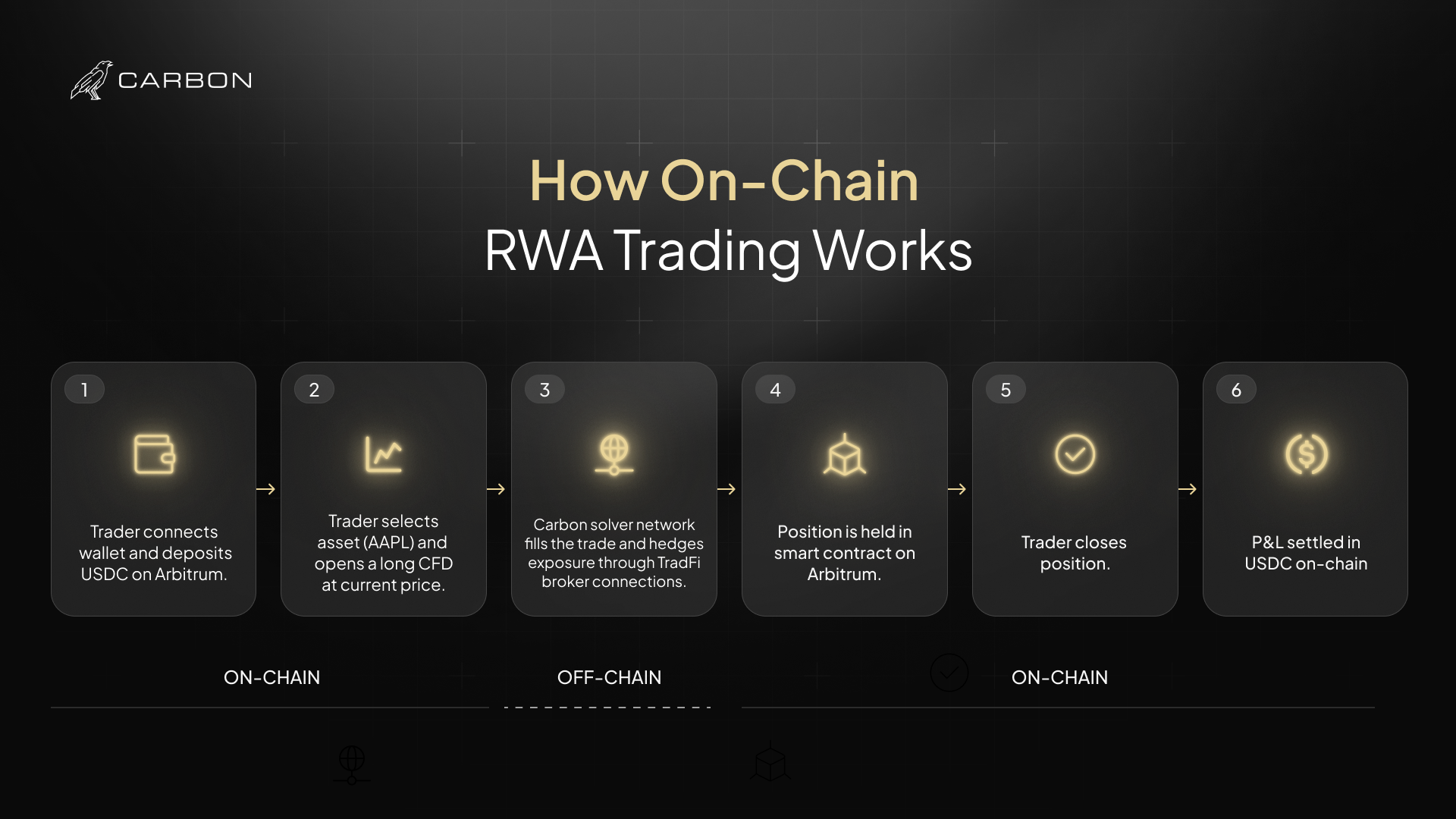
On-chain RWA exposure through CFDs works through a price tracking and settlement model, not through actual ownership of the underlying assets.
Price feeds. Carbon’s solver network is connected to institutional price sources for each asset class. Equity prices are tracked against real exchange data through TradFi broker connections. Forex rates derive from institutional FX venues. Commodity prices are tracked against relevant spot and futures markets.
Position management. When you open a Tesla CFD at $400, you’re not buying Tesla stock. You’re entering a position that tracks Tesla’s price. If Tesla rises to $440, you close and receive the $40 price difference in USDC. If it falls to $360, you would pay the $40 difference. Your collateral (USDC) is held in a smart contract on Arbitrum throughout. You can verify your position, margin, and P&L on-chain at any time.
Solver hedging. The solver filling your trade hedges their exposure on the underlying markets. For an equity CFD, this means the solver holds an offsetting position through connections to the actual equity market. This is what ensures the price you’re tracking reflects real market conditions and real depth, not an oracle approximation.
Settlement. All settlement happens in USDC on Arbitrum when you close your position. No physical delivery, no asset custody, no cross-chain bridging. P&L is calculated and paid in USDC.
Advantages Over Traditional Access
The comparison is with a traditional retail broker offering stocks, forex, or commodities.
No account required. Opening a brokerage account typically takes one to three days, requires government ID, often requires a local bank account, and may include a waiting period before trading is enabled. On Carbon, you connect a wallet and trade.
No geographic restrictions at the platform level. Traditional brokers are licensed in specific jurisdictions and restrict access accordingly. Many brokerage services are unavailable to users in certain countries or require expensive workarounds. Carbon’s smart contracts don’t enforce geographic restrictions — access is determined by wallet, not by passport.
Self-custody of collateral. Your USDC collateral is held in smart contracts, not in a broker’s account. If Carbon’s frontend goes offline, your funds remain on-chain and accessible. Brokerage accounts, even regulated ones, carry counterparty risk.
Extended access hours. Traditional equity markets close. NYSE is open 9:30am–4:00pm ET on business days. Carbon’s on-chain infrastructure is always available. Equity CFD pricing reflects the underlying market’s trading hours for active price movement, but you can enter and exit positions at any time.
Composability with DeFi. Your on-chain position and collateral can potentially interact with other DeFi protocols and strategies in ways that aren’t possible with a traditional brokerage account.
How Carbon Delivers On-chain RWA Trading
The challenge in on-chain RWA trading is liquidity quality. You can build a synthetic position on-chain that claims to track Apple stock, but if the liquidity behind it is thin, price impact on any meaningful trade size will be severe and spreads will be wide.
Carbon’s approach is to source liquidity where it already exists — major CEXs for crypto assets, and institutional TradFi broker connections for equities, forex, and commodities — and bring that into a solver network that competes to fill each trade.
When you submit a trade on a Carbon RWA market, the solver network receives your intent. Solvers connected to relevant markets compete to fill it at the best available price. The winning solver executes their hedge through actual market connections, then settles your trade on-chain.
The result is that your execution price reflects real market depth. For a major equity like Tesla or Apple, that means institutional-grade execution quality on an on-chain, self-custodial platform. Not the depth of a synthetic pool. Actual market depth, brought on-chain through the solver model.
Limitations and Trade-offs
On-chain RWA trading is not equivalent to direct asset ownership, and it has real limitations that traders should understand.
No direct ownership. You’re tracking prices, not holding assets. You don’t have voting rights on shares. You don’t receive dividends directly, though significant corporate actions can be reflected in price adjustments. For traders who want actual equity ownership, tokenized securities are a separate category with different infrastructure and regulatory requirements.
Market hours for equity pricing. Stock CFD prices track the underlying market, which has defined trading hours. Outside of NYSE and NASDAQ hours, price movement on equity CFDs reflects the after-hours and futures market, which can differ from the previous close. Traders should understand this context, particularly around major earnings or macro events that occur outside regular hours.
Oracle and solver dependency. RWA CFDs depend on accurate price feeds and reliable solver connections to the underlying markets. If a solver’s connection to an equity broker is disrupted, execution quality on equity CFDs degrades. Carbon’s solver network is designed with redundancy, but the dependency on external market connections is real.
Regulatory environment. The regulatory status of on-chain derivatives on traditional assets varies by jurisdiction. Users are responsible for understanding the legal environment in their location. Carbon does not provide legal advice.
The Bigger Picture
The NYSE and other major exchanges are actively exploring blockchain settlement infrastructure. Tokenized securities are attracting serious institutional capital. Major financial institutions are building on-chain rails for traditional assets. The question of how TradFi and DeFi converge is being actively worked on from both sides.
Carbon sits at a specific position in this evolution. Rather than waiting for native tokenization of equities — which requires regulatory frameworks, custodial infrastructure, and compliance overhead that will take years to fully develop — Carbon uses the derivative route. CFDs track prices without requiring actual asset tokenization. The exposure is synthetic. The price is real.
As the regulatory environment evolves and tokenized equities mature, the on-chain derivative market for RWAs will evolve alongside it. The infrastructure Carbon is building now — solver-based execution, real liquidity sourcing, USDC settlement on Arbitrum — is directly applicable to whatever structure the market converges on.
For traders, the opportunity is current. 200+ RWA markets, real liquidity, on-chain settlement, accessible today from any crypto wallet.
Start Trading
Carbon’s on-chain RWA markets are launching soon. In the meantime, trade 550+ crypto perpetual pairs with zero fees and up to 75x leverage.